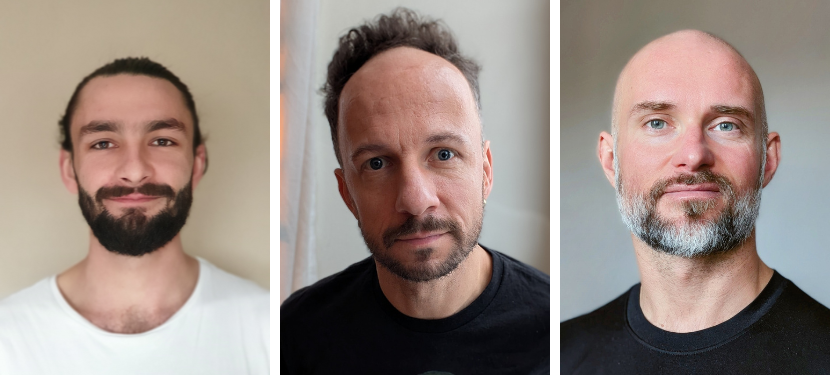
We are starting the new year by welcoming wonderful people into our space! They are our residents: Mikołaj Karczewski, Piotr Stanek, and Konrad Kurowski, selected through an open call we organized last year.
We are truly excited to be hosting, for the first time, a residency that is not focused on a final product, but rather on the creative process itself. The research residency is a constantly morphing entity—new to us—and we are still trying to grasp its framework, while simultaneously handing that space over to the residents. We are also asking ourselves whether defining such a framework is necessary at all, and if so, how it can be shaped while maintaining inclusivity.
We are allowing ourselves the space to re-define this project, and we are genuinely curious to see what the artists’ work will bring.
We already invite you to a meeting with the residents and a conversation around their process!
January 21 | 7:00 PM | KCC Studio
Admission: 10 PLN. “Open Studio” tickets available at the NCK box office or ticket machine.
From the residents:
The research–choreographic residency is conceived as a shared space of exploration, centered around the notion of “masculinity after patriarchy.” We understand it not as a reaction, a correction, or an attempt to “fix” something, but as an open question: what forms of presence, care, and relations between men might emerge beyond the logic of power, domination, and hierarchy?
Our point of departure is the concept of discord, understood as tension and fragmentation—not as a problem to be solved, but as a field of attentiveness in which new qualities of being together may arise.
We aim to create space for difference and the non-homogeneity of the experiences of three men, grounded in themes that are important to us: masculinity, queerness, and migration—without the need to separate them, standardize them, or close them into stable forms. We consciously move away from the pressure of outcomes, linearity, and academic hierarchy, treating fragmentation, intuition, and unreason as fully valid elements of the creative process.
Mikołaj Karczewski
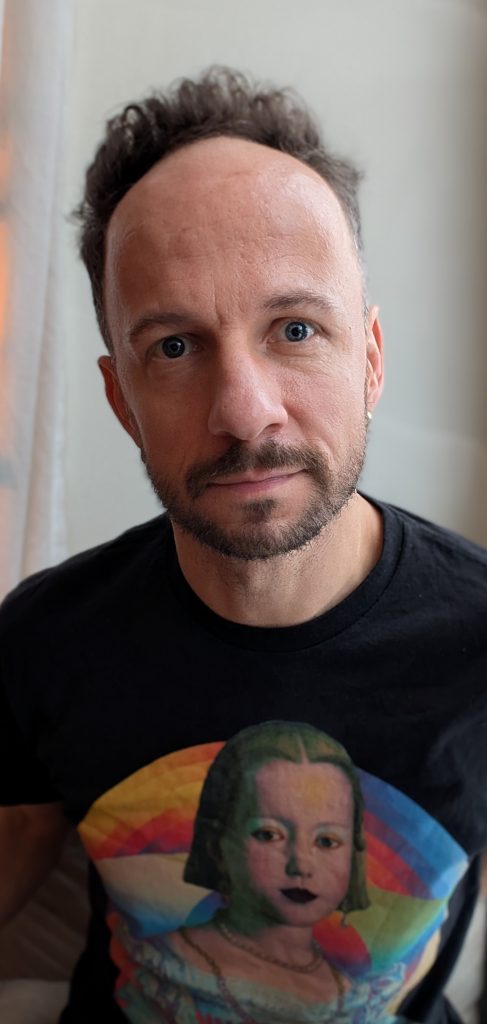
Mikołaj Karczewski (he/him) is a dancer and choreographer working in Poland and internationally. His practice moves between different working systems—dance, theatre, and opera—focusing on spaces of encounter free from hierarchy and the dominance of a single language. For him, movement is both a tool of communication and a way of returning to the body, attentiveness, and the pleasure of inhabiting it.
As a performer, he has collaborated with many acclaimed directors and choreographers, including Cezary Tomaszewski, Magdalena Piekorz, Monika Strzępka, Mateusz Pakuła, Jędrzej Piaskowski, as well as Colleen Thomas Young, Joe Alter, Elisabetta Consonni, and Rachel Erdos.
Since 2016, he has also been working as a choreographer in drama theatres and opera houses. In recent years, his work has been presented internationally, including in Switzerland—in the six-hour finale of Wagner’s Götterdämmerung (Twilight of the Gods), directed by Ewelina Marciniak at Theater Bühne Bern—as well as in productions such as Złote Płyty at Teatr Capitol in Wrocław, My Year of Rest and Relaxation in Graz, Puppenhaus. Kuracja at TR Warszawa, and Salome at the Residenztheater in Munich.
Since 2012, he has been closely connected to the Danish dance scene. For 14 years, he collaborated with choreographer Palle Granhøj and the company Granhøj Dans, performing in seven productions, four of which received the prestigious Reumert Award for Best Dance Performance of the Season. For his role as the Charlatan in Petrushka – Extended, he was nominated for Best Dancer of the Year in 2016. Together with the company, he has toured in 49 countries worldwide, and with his solo project Stone-Face-Book, he represented Denmark twice at the Edinburgh Festival Fringe in 2022 and 2023.
In 2020, he began collaborating with another prominent Danish company, DON GNU. For his performances in two of their productions, he received a nomination for Best Dancer of the 2023 season, awarded by CPH Culture.
He is a recipient of the Polish Ministry of Culture and National Heritage’s Young Poland (Młoda Polska) scholarship (2020), within which he created his first original work, Cornerstone. Between 2013 and 2021, he also worked as a lecturer in contemporary dance at the Faculty of Dance Theatre (PWST WTT) in Bytom.
Piotr Stanek
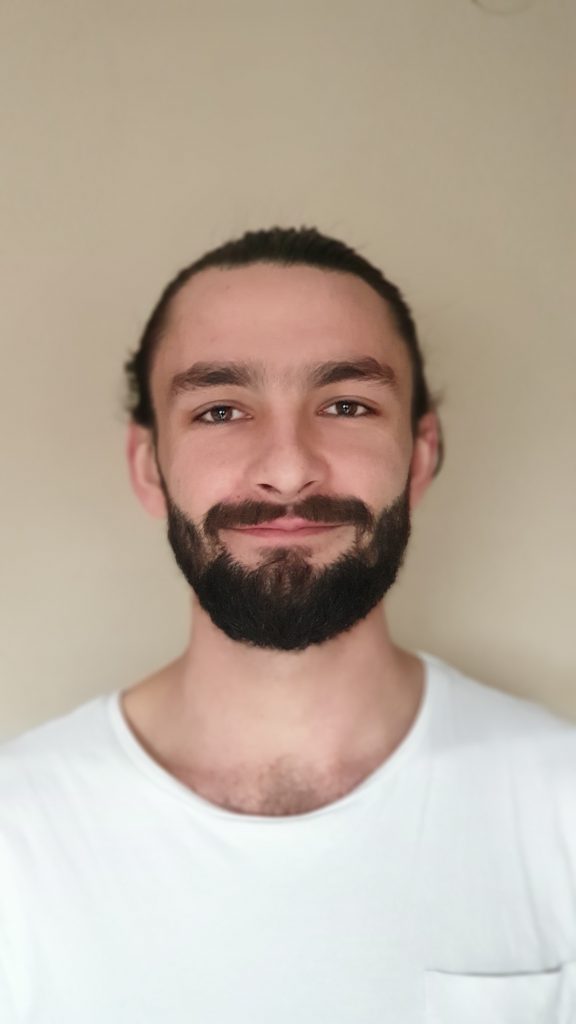
Piotr Stanek is an actor, dancer, choreographer, and performer. He graduated from the Stanisław Wyspiański Academy of Theatre Arts in Kraków, Faculty of Dance Theatre in Bytom. He works as an independent artist across theatre, choreography, film, and opera. He is a recipient of a cultural scholarship from the West Pomeranian Voivodeship.
He created the choreography for the opera Ariadne auf Naxos, directed by Mariusz Treliński at the Grand Theatre – Polish National Opera in Warsaw, as well as for the musical Groundhog Day at Teatr Capitol in Wrocław, directed by Marcin Wierzchowski. He collaborates with Teatr Dada von Bzdülöw, Teatr O.de.la, and the Sticky Fingers Club collective. In recent years, he has also worked with, among others, Leszek Bzdyl, Simon Basani, Joe Alter, Marek Christopher Klee, Marta Bury, Dominika Knapik, Maciej Gorczyński, Cezary Tomaszewski, Katarzyna Minkowska, Dominik Więcek, Daniela Komędera, and Marysia Stokłosa.
Productions featuring his work have been presented internationally, including in New York, San Diego, Tijuana, Kiel, Brussels, and Osaka.
In collaboration with other artists, he creates original projects such as Scores for Yearning. The Concert, Imaginary Archive, the solo performance Arizona, The Amazing World of Obłoczek, and SONNETS – The Age of the Hypochondriac. He co-created the choreography for the concert Walpurgisnacht as part of the Opera Rara Festival 2024. He also assisted in the creation of choreography and performed in the films The Peasants, Winterreise, and The Ugly Stepsister.
Konrad Kurowski
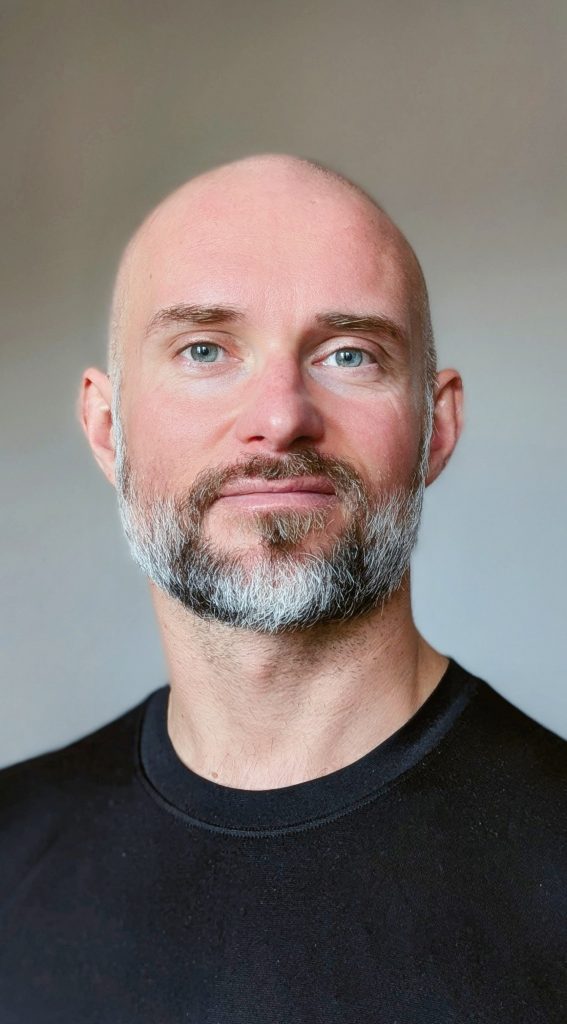
Konrad Kurowski (he/him) is a dramaturg, curator, and facilitator of artistic processes affiliated with the Centre for Culture in Lublin. In his practice, he combines somatic work with reflection on the social dimensions of care.
From 2014 to 2023, he was a member of the Lublin Dance Theatre, and in 2023–2024 he co-created the curatorial team of Lublin as the European Capital of Culture. He has also worked in the Accessibility Team as well as the Team for the Prevention of Abuse and Discrimination.
Since 2020, he has been developing an original movement-based practice focused on embodying and exploring the phenomenon of care. Its artistic manifestations include the choreographic works Exercises in Being, Looking, and Acting (Galeria Labirynt, 2021), WORK IT! (Przestrzenie Sztuki, 2021), and Syzygium. Practices of Active Hope (Warsztaty Kultury, 2023). Together with Mikołaj Karczewski, he co-creates Strefa Półcienia (Penumbra Zone), a series of dance workshops for blind and visually impaired participants (2024–2025).
As a dramaturg, he collaborates with artists including Mikołaj Karczewski, the Sticky Fingers Club collective, Elisabetta Consonni, Marta Wołowiec, Piotr Stanek, Olga Bury, Joanna Woźna, and Magdalena Kowala. The performance Glory Game (choreography by Dominik Więcek), for which he created the dramaturgy, was selected among the twenty best performances of 2025 by the European network Aerowaves and was distinguished by the Polish Dance Platform 2026.
He has curated the International Dance Theatre Meetings in Lublin and co-created dance initiatives such as Przestrzenie Sztuki Lublin, the Polish Dance Network, the Przestrzeń Wspólna collective, and Aerowaves. He holds a degree in cultural studies. Privately, he is an activist for human rights and for queer and neurodivergent communities.
***
Co-financed by the Minister of Culture and National Heritage from the Culture Promotion Fund — a state special-purpose fund — as part of the “Dance” programme, implemented by the National Institute of Music and Dance.